

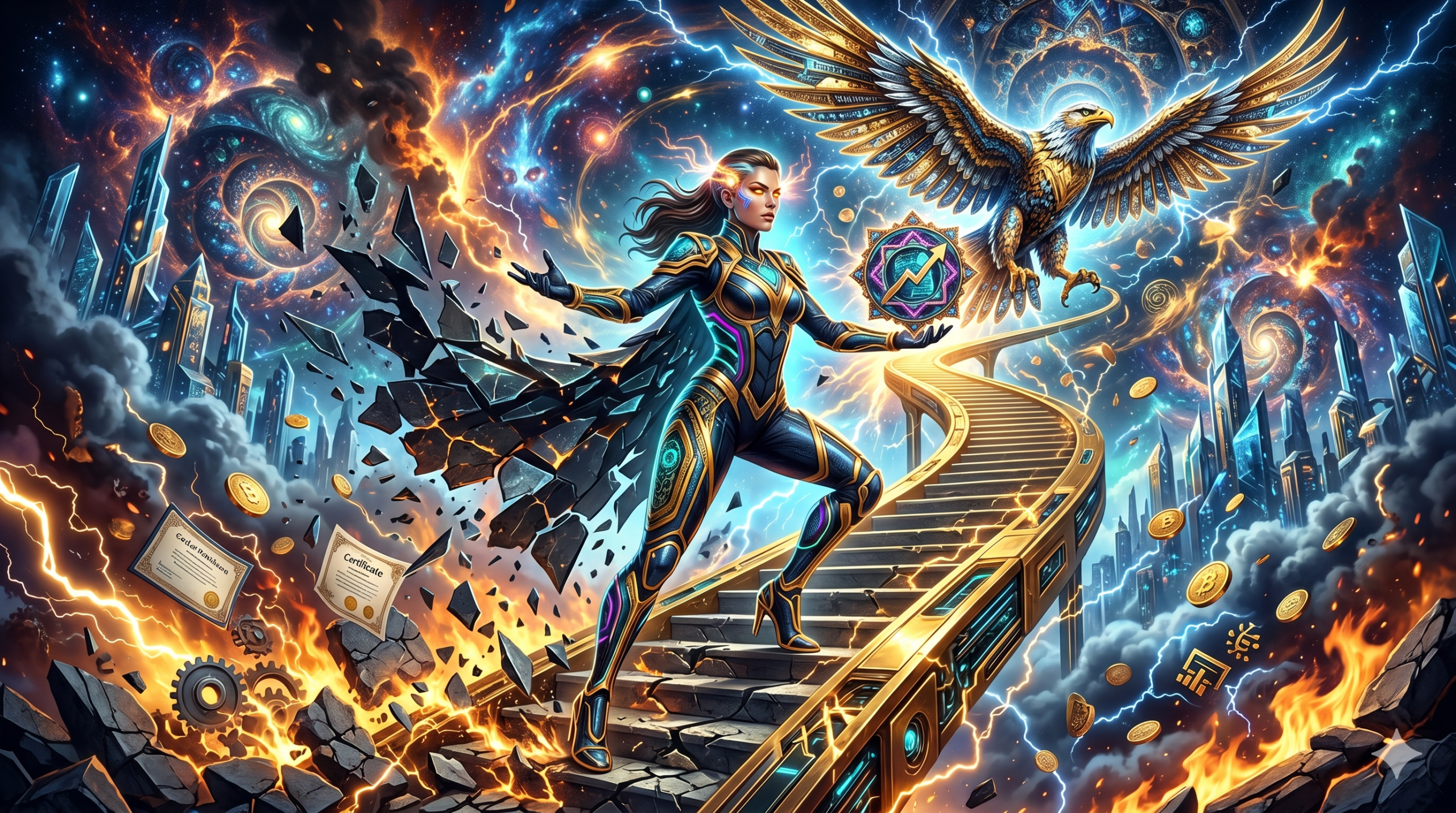
For decades, we were sold the myth of the “Career Ladder.” The imagery was simple: you find a sturdy wall, you put your foot on the first rung, and you climb. As long as you didn’t look down and kept moving upward, you were told you were succeeding. But in the volatile, high-velocity economy of 2026, the ladder is a dangerous metaphor. Ladders are rigid; they don’t move. And in a world where entire industries can be automated or disrupted in a single quarter, a rigid path is a path toward obsolescence.
Today, your career isn’t a ladder; it’s an open-world territory. There are no pre-drawn maps, no guaranteed rungs, and the weather changes every hour. In this environment, you don’t need a ladder; you need a Career Compass. Strategic navigation isn’t about knowing exactly where you’ll be in ten years—that’s a hallucination. It’s about having the psychological tools to determine your “True North,” the cognitive flexibility to pivot when the terrain shifts, and the high-agency mindset to choose your own path rather than drifting along with the current.
The Internal North Star vs. The External Noise
The biggest challenge in career navigation isn’t a lack of information; it’s an overabundance of Social Proof. We are constantly bombarded with “Success Stories” that are actually just survivors of a different era. We see people chasing titles, salaries, and prestige because that’s what the “Map” says they should do. This is Career Colonization—allowing the expectations of your parents, your peers, or the “Algorithm” to occupy your mental real estate.
To build a Career Compass, you must first define your Internal North Star. This is the intersection of three psychological anchors:
- Core Competencies: What are the “High-Signal” skills that you can perform with “Effortless Effort”?
- Intrinsic Drivers: What would you do even if the “Brand Premium” and the social status were stripped away?
- Lifestyle Sovereignty: What does “Winning” actually look like for your daily life? (e.g., Do you value autonomy over income, or impact over security?)
When these anchors are clear, your compass becomes a filter. You stop asking, “Is this a good job?” and start asking, “Does this move me closer to my North Star?”
Tool 1: The Opportunity Cost Audit
Most people choose their next career move based on what they are gaining—the higher salary, the better title, the bigger office. But the strategic navigator looks at what they are Sacrificing. This is the Opportunity Cost Audit.
Every “Yes” to a new role is a “No” to a thousand other possibilities.
- Is that promotion worth the loss of your “Cognitive Sovereignty”?
- Is that high-paying corporate job worth the “Burn” that prevents you from pursuing “Alchemical Hobbies”?
- Are you trading your “Relational Capital” for a temporary spike in status?
The Tactic: Before making a major move, perform a “Brutal Autopsy” of the offer. List everything you are giving up—time, energy, focus, and alternative paths. If the gain doesn’t significantly outweigh the sacrifice, you aren’t advancing; you’re just swapping one set of golden handcuffs for another.
Tool 2: Wayfinding (The Art of Iterative Steps)
In design thinking, “Wayfinding” is the process of navigating an unfamiliar environment through small, exploratory steps rather than a master plan. In your career, this means moving from “Planning” to Constant Experimentation.
The “Career Compass” doesn’t give you a 50-mile view; it gives you the direction for the next 50 yards.
- The Micro-Pivot: Instead of quitting your job to start a business, start a “Side Lab” to test the “Market Supremacy” of your idea.
- The Information Interview: Use “Tactical Empathy” to interview people three steps ahead of you. Don’t ask for a job; ask for their “Psychological Blueprint”.
- The Skill Stack: Use your “Deep Work” periods to acquire one “Non-Linear” skill every quarter that makes you more “Antifragile”.
By focusing on the next step rather than the final destination, you reduce the “Inertia Tax” and maintain your momentum.
Tool 3: Neutralizing the Sunk Cost Trap
One of the most powerful psychological forces keeping us on the wrong path is The Sunk Cost Fallacy. We stay in toxic roles or dying industries because we’ve already “invested” five years there. Our brains tell us that leaving now would be a waste of that time.
But the time is gone regardless. Strategic navigation requires the courage to treat your past as Data, not a “Debt.”
- If the industry is shifting, your five years of experience is a “Sunk Cost.”
- If your values have changed, your previous “Career Ladder” is a “Sunk Cost.”
The Compass Rule: If you wouldn’t choose your current path today starting from zero, then you are on the wrong path. The “Discipline Protocol” isn’t about staying the course no matter what; it’s about having the discipline to walk away from a “Good” opportunity to make room for a “Great” one.
Tool 4: The Network as a Radar System
Your “Relational Capital” acts as the radar for your compass. You cannot see the entire territory, but your network can.
High-impact connections provide Early Warning Signals. They tell you when a market is about to shift, when a company culture is souring, or when a “Hidden Opportunity” is about to emerge. To use this radar effectively, you must move from “Networking” to Synergistic Power.
- Don’t just collect contacts; build a “Brain Trust” of people who challenge your perspective.
- Practice “Asymmetric Giving” to keep your “Social Bank Account” in surplus.
- Use “Radical Transparency” about your North Star so that people know exactly which opportunities to send your way.
Conclusion: The Sovereign Navigator
In 2026, the only security you have is your own ability to navigate. Companies will rise and fall; technologies will evolve and disappear; but your Career Compass is yours to keep.
Strategic navigation is an act of Sovereignty. It is the refusal to be a passenger in your own professional life. It requires you to be comfortable with “Strategic Discomfort”, to be ruthless with your “Opportunity Cost,” and to be relentlessly protective of your “Internal North Star.”
The territory is wide, the stakes are high, and the map is blank.
Trust your compass. Take the next step. Own the journey.













Leave a Reply