
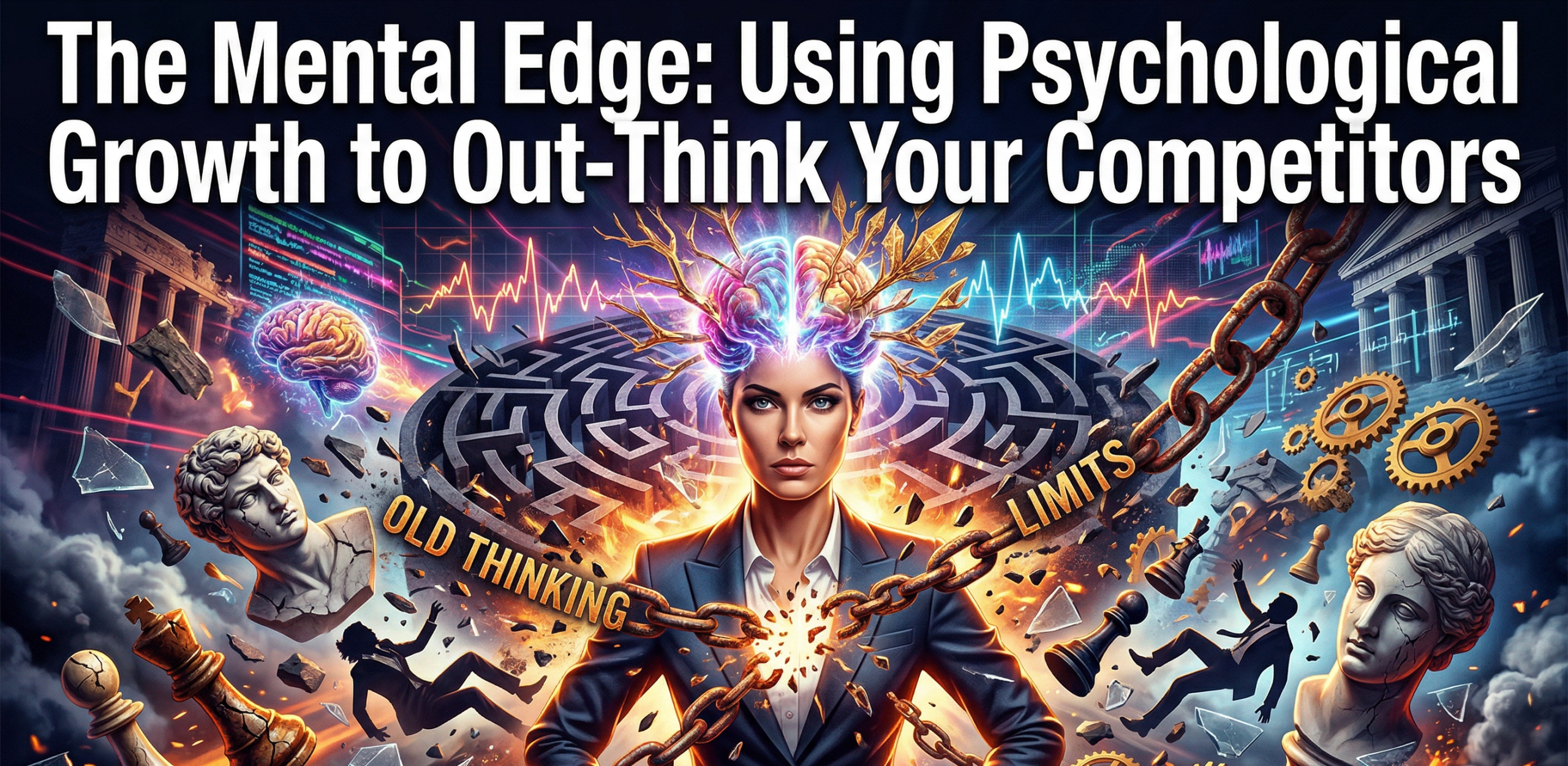
In a world where information is a commodity, “knowing more” is no longer a sustainable advantage.
Your competitors have access to the same data, the same software, and the same consultants as you do. If you are relying on your knowledge base to win, you are playing a game that is rapidly being automated. The real competitive edge in 2026 isn’t what you have in your head; it’s how your head works.
Most people are “Linear Thinkers.” They see a problem, they look for a past solution that worked, and they apply it. This works in a stable environment. But in a volatile one, linear thinking is a death sentence. To out-think the field, you need the Mental Edge—the ability to utilize advanced psychological frameworks to see patterns, biases, and opportunities that are invisible to the “experts.”
The Map is Not the Territory
One of the most profound barriers to growth is the confusion between our “Internal Map” and the “External Reality.”
We all walk around with mental models of how the world works. We have a “Map of Sales,” a “Map of Leadership,” and a “Map of Success.” The problem is that many of our maps were drawn in 2015. They are outdated, incomplete, and—in some cases—flat-out wrong.
Psychological growth is the process of constantly Updating the Map. High-performers don’t get married to their ideas. They treat their beliefs as “Beta Versions” that are meant to be tested, broken, and refined. When a competitor hits a wall, they assume the “Territory” is the problem. The Mental Edge allows you to realize that the Map is the problem, giving you the agility to pivot while everyone else is still arguing with reality.
The Power of Mental Models
If you want to out-think your competitors, you need a larger “Lattice” of mental models. Most people solve problems using only the tools of their specific discipline (e.g., a lawyer looks for legal solutions; a marketer looks for branding solutions).
The mental edge comes from Cross-Pollination. It’s the ability to apply the principles of biology to business, or the laws of physics to team dynamics.
The Metacognitive Advantage
The highest level of psychological growth is Metacognition—the ability to think about your own thinking.
Most people are unaware of the “Bugs” in their cognitive software. They are driven by confirmation bias (looking for info that agrees with them), loss aversion (staying with a failing project because they’ve already spent money on it), and social proof (doing what everyone else is doing).
The person with the Mental Edge has an “External Auditor” in their mind. They catch themselves in the middle of a bias and manually override it.
“I notice I’m only listening to the people who agree with this strategy. Who is the person I respect most who hates this idea? I need to talk to them immediately.”
This isn’t just “being open-minded.” It is a Strategic Defense Mechanism. By auditing your own logic, you eliminate the blind spots that lead to expensive professional and personal errors.
The Friction of Intellectual Growth
Real psychological growth isn’t pleasant. It feels like Confusion. If you aren’t periodically feeling like a beginner, you aren’t growing; you’re just rehearsing. The Mental Edge requires you to seek out “Disconfirming Evidence.” It requires you to read books you disagree with, talk to people who challenge your worldview, and intentionally “break” your most cherished strategies.
You are building Cognitive Plasticity. The more often you force your brain to re-wire itself around a new concept, the faster you can adapt when the market shifts. While your competitors are busy “protecting” their old ideas, you are busy out-growing them.
The 30-Day Mental Edge Training
This month, stop focusing on what you’re learning and start focusing on how you’re thinking.
- Week 1: The Bias Audit. Identify the “Sunk Cost” in your life. What is a project, a habit, or a relationship you are staying in just because you’ve already invested time? Practice the “Zero-Base” test: “If I weren’t already doing this, would I start it today?”
- Week 2: The Inversion Exercise. Take your biggest goal for the year. Now, write down exactly how you could guarantee its failure. (e.g., “I could fail by never delegating,” “I could fail by ignoring the data.”) Now, build your schedule to protect against those specific failures.
- Week 3: The Second-Order Deep Dive. For every major decision this week, write down the “Second-Order Effect.” If you say “yes” to this client, what does it mean for your capacity six months from now? What does it mean for your team’s morale?
- Week 4: The First-Principles Reset. Pick one “Standard Industry Practice” you follow. Strip it down. Why do we do it this way? Is there a more efficient, modern way to achieve the same goal?
The Ultimate Monopoly
Knowledge can be stolen. Ideas can be copied. But a high-functioning, agile mind is a Monopoly.
The Mental Edge is the only asset that compounds over time without being subject to inflation or market volatility. The more you grow psychologically, the more clearly you see the world. And the more clearly you see the world, the more obvious the opportunities become.
Stop trying to work harder than your competitors.
Start trying to think better than them.
The race isn’t won by the one with the most information.
It’s won by the one with the best map.
Update your map.
If you were to look at your current career strategy through the lens of “Inversion,” what is the most obvious “stupid mistake” you are currently making that could lead to a plateau?














Leave a Reply