
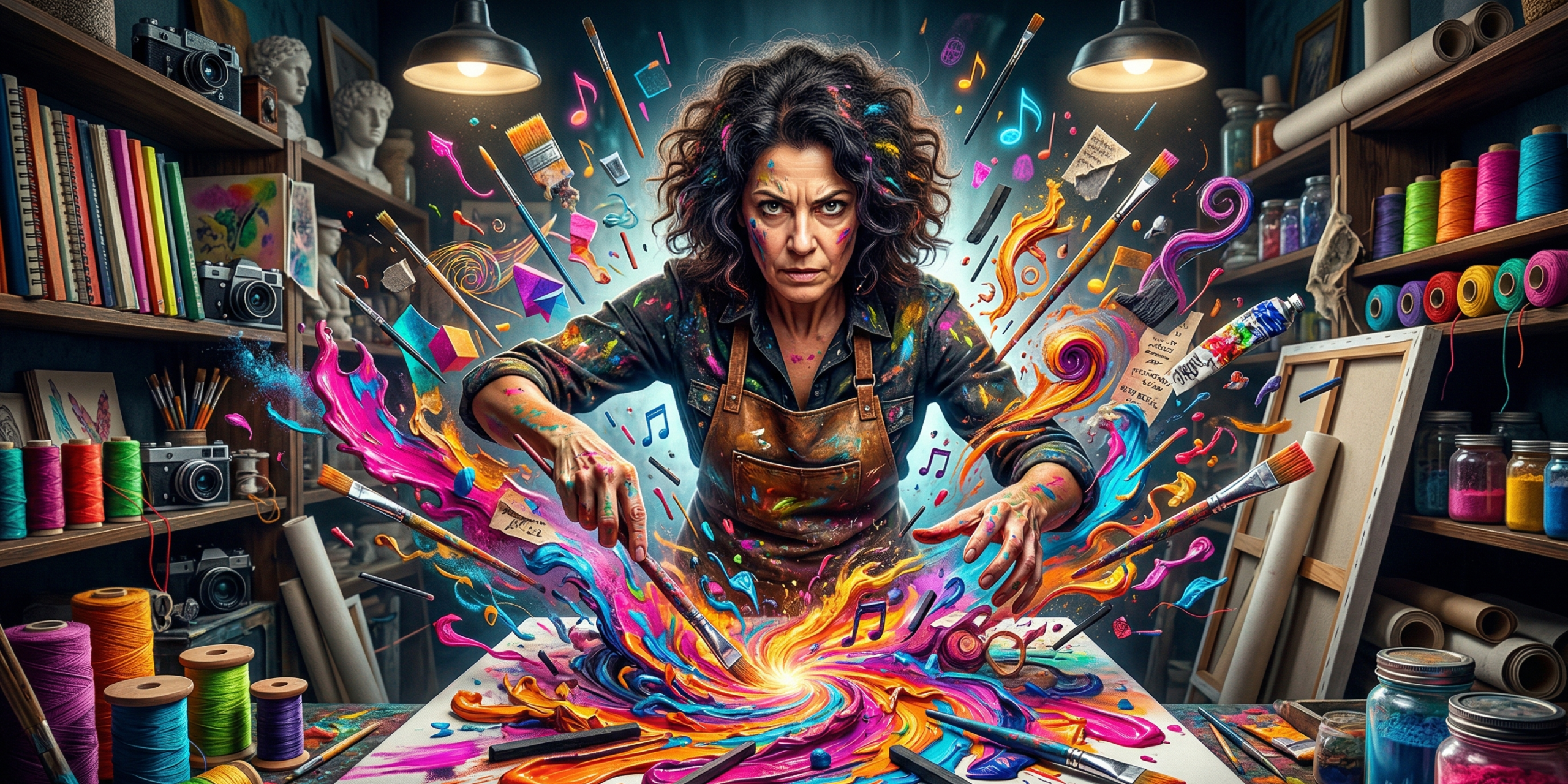
In the hyper-optimized landscape of 2026, we have largely optimized ourselves into a corner of passive consumption. We are the most entertained generation in human history, yet we are arguably the most restless. We consume “content” with a voracity that would have baffled our ancestors, yet we often feel a sense of profound “Internal Emptiness.” This is because consumption is a one-way street; it fills the mind but starves the spirit.
The Creative Spirit is the internal engine that moves you from a “Consumer” to a “Producer” of reality. It is not reserved for “artists” or “creative professionals.” It is a fundamental human requirement for “Cognitive Sovereignty”. When you create something—whether it’s a line of code, a piece of furniture, a strategic plan, or a garden—you are performing an act of self-definition. You are declaring that your inner life has the power to manifest in the external world. To nurture the creative spirit is to build a “Sanctuary of Expression” that protects your identity from being colonized by the “Algorithmic Noise” of the digital age.
The Consumption Vacuum vs. The Creative Overflow
Consumption is an act of Input. It is necessary, but in excess, it creates a “Vacuum” effect where your own thoughts and intuitions are sucked out and replaced by the prefabricated ideas of others. Creation is an act of Overflow. It is the process of allowing your internal insights, tensions, and curiosities to spill out into a tangible form.
To reclaim your creative spirit, you must intentionally reverse the ratio. You must move from a state where you are a “Target Audience” to a state where you are an “Architect of Meaning.”
Pillar 1: The Sanctuary of “Low-Stakes” Play
We often kill our creative spirit by demanding that everything we do be “Productive” or “Monetizable” (#19). When you apply the “Market Supremacy” framework to your inner life, you create a “Performance Anxiety” that freezes the imagination.
The first step in nurturing the creative spirit is establishing a Sanctuary of Low-Stakes Play. This is a space—physical or mental—where the quality of the output is irrelevant.
- The Messy Sketchbook: Drawing things that will never be shown.
- The Private Journal: Writing thoughts that will never be published.
- The “Zero-Pressure” Side Project: Building a tool or a hobby just to see how the “Physics” of the craft works.
In this sanctuary, you are the “Sovereign”. You are allowed to fail, to be “amateur”, and to follow “useless” curiosities. This play is the “Research and Development” phase of your soul. It’s where your most profound professional breakthroughs actually begin.
Pillar 2: Tactile Resonance (The Analog Bridge)
In 2026, our lives are increasingly lived in “High-Fidelity Virtual Spaces.” While these tools are powerful, they often lack Tactile Resonance. There is a psychological “Feedback Loop” that occurs when your hands interact with physical materials—wood, paint, soil, or even the keys of a piano.
Physical creation forces you to deal with Objective Friction. Unlike a digital document where you can “undo” a mistake, the physical world demands “Kinetic Resilience”. You have to adjust to the grain of the wood or the drying time of the ink. This friction grounds your inner life. It pulls you out of the “Cognitive Looping” of your worries and into the “Flow State” of the present moment. Nurturing the creative spirit requires at least one “Analog Anchor” to keep your mind from drifting into the digital void.
Pillar 3: The Ritual of “Internal Audits”
Creative expression is the primary tool for Internal Maintenance. Often, we carry around “Emotional Debt” or “Cognitive Clutter” that we don’t even know is there. Creation acts as a “Borehole” into the subconscious.
When you create, you are performing a “Brutal Autopsy” of your own interior state.
- Why did I choose this specific word?
- Why am I drawn to this specific problem?
- What “Hidden Signal” is my subconscious trying to send through this project?
By externalizing your inner life, you gain “Psychological Leverage” over it. You can see your fears, your ambitions, and your “Internal Blueprints” more clearly when they are sitting on a table in front of you rather than swirling around in your head.
Pillar 4: Protecting the “Incubation Window”
The creative spirit is delicate; it requires time to “Incubate.” In our culture of “Constant Connectivity,” we often abort our best ideas by sharing them too early. When you tell everyone about your “Big New Project” before you’ve actually started, you get a “Counterfeit Dopamine” hit that tricks your brain into thinking the work is already done. This is the Substitution Effect.
To nurture your spirit, you must practice Strategic Secrecy. * Keep your best ideas in the “Incubation Window” for at least two weeks.
- Don’t look for “Social Proof” or validation from your “Connection Multipliers” too early.
- Let the idea gain “Momentum” in the private theater of your mind before you expose it to the “Friction” of the market.
Conclusion: The Sovereign Creator
The Creative Spirit is not a luxury; it is your Insurance Policy against Burnout. It is the “Economic Bedrock” of your mental health. In a world that wants to turn you into a predictable unit of consumption, the act of creation is your ultimate “Rebellion.”
When you create, you are building your “Internal Infrastructure.” You are proving that you are a “High-Agency” human being who can generate value, meaning, and beauty out of thin air. This confidence bleeds into your career, your relationships, and your leadership. You stop being afraid of “Loss” because you know that you are a “Generator.”
Nurture the spirit. Build the sanctuary. Overflow into the world.


Leave a Reply