
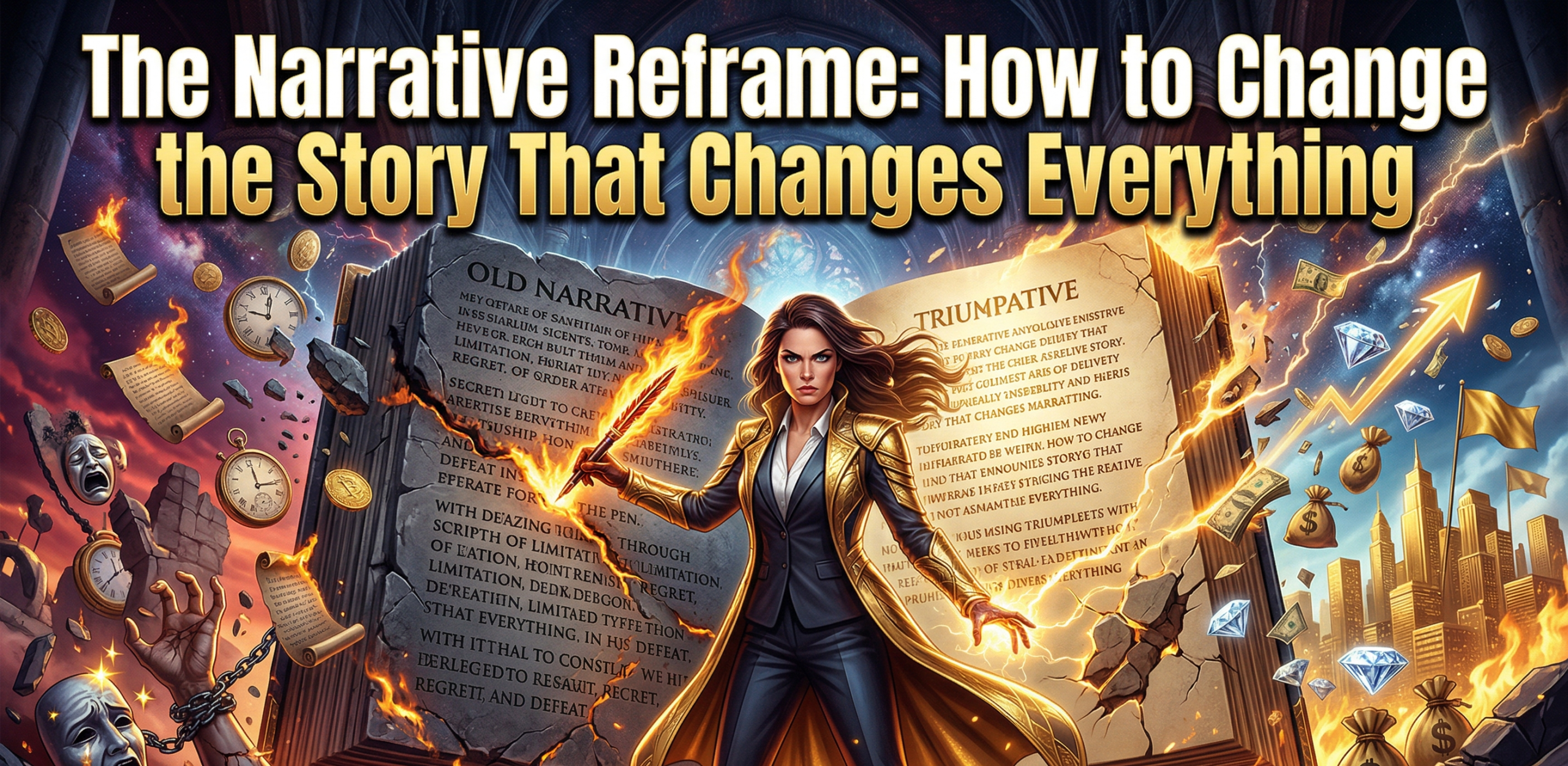
We have a fundamental misunderstanding of how we experience reality.
We believe that we are objective observers of our lives—that an event happens, we see it, and we record it as a “fact.” We think our memories are like security footage: a neutral, unedited account of the truth. But in psychology, we know that the human brain is not a camera; it is a Master Storyteller.
Between every event and your emotional response to it, there is a “Filter.” This filter takes raw data and wraps it in a narrative. It assigns blame, it determines meaning, and it predicts the future. This is your Internal Narrator. The problem is that most of us are walking around with a narrator who is stuck in “Tragedy Mode.” We are telling ourselves stories of limitation, rejection, and “not enough-ness,” and then wondering why we feel stuck.
If you want to change your life, you have to stop trying to change the facts and start changing the Reframe.
The Gap: Fact vs. Interpretation
A “Fact” is something that can be proven in a court of law. An “Interpretation” is the story you tell yourself about that fact.
The fact is neutral. The narrative is where the power (or the paralysis) lives. Reframing isn’t about “toxic positivity” or lying to yourself. It’s about choosing the most functional interpretation of a situation. If your story makes you feel powerless, it’s a bad story. Rewrite it.
The “Yet” Protocol: The Simplest Linguistic Shift
One of the most powerful tools in the growth mindset is a single, three-letter word: Yet.
When you say, “I don’t know how to do this,” your brain hears a “Stop” sign. It closes the file. The narrative is: Incompetence.
When you say, “I don’t know how to do this yet,” your brain hears a “Loading” bar. It keeps the file open. The narrative is: Process.
The “Yet” protocol shifts you from a static identity (who I am) to a fluid identity (who I am becoming). It acknowledges the current friction without turning it into a permanent failure. In 2026, where the half-life of any skill is shrinking, your ability to stay in the “Yet” state is your greatest professional asset.
The Perspective Flip: From “To Me” to “For Me”
Most people live in a state of Passive Victimhood. They believe that things are happening to them.
- “Traffic happened to me.”
- “The market happened to me.”
- “This difficult boss is happening to me.”
The Architect’s Mind makes a radical shift: Everything is happening FOR me.
Even the setbacks, the “bad luck,” and the conflicts are treated as Custom-Designed Training. When you assume that every obstacle is actually a piece of data designed to help you level up, your relationship with stress changes. You stop being a victim of the world and start being a student of it. You move from “Why is this happening?” to “What is this teaching me?”
The Narrative Hook: Beware of Your “Always” and “Nevers”
Your narrator loves superlatives. It loves to say things like, “I always mess up,” or “I’ll never be successful.”
These are Absolute Narratives. They are psychological traps designed to keep you safe by preventing you from trying. When you catch yourself using an absolute, you are witnessing your brain’s attempt to “close the loop” on your potential.
Break the hook by introducing Nuance. Replace “I always mess up” with “In this specific instance, I made a mistake that I can correct next time.” By narrowing the scope of the failure, you prevent it from staining your entire identity.
The 30-Day Narrative Audit
This month, you are the editor-in-chief of your own internal script.
- Week 1: The “Story” Catch. For seven days, every time you feel a surge of negative emotion (anger, shame, anxiety), stop and ask: “What is the story I am telling myself right now?” Just name it.
- Week 2: The “Yet” Integration. Intentionally add the word “yet” to every self-criticism. “I haven’t hit my revenue goal… yet.” “I’m not a great leader… yet.”
- Week 3: The “For Me” Challenge. Pick one major frustration in your life. Write down three ways that this specific problem is actually happening for you. What is it forcing you to learn? What is it protecting you from?
- Week 4: The Superlative Strike. Delete “always” and “never” from your vocabulary when describing yourself. Replace them with specific, time-bound observations.
The Final Edit
Your life is not a series of events; it is a series of meanings. You cannot control what the world throws at you. You cannot control the market, the weather, or the moods of other people. But you have 100% authority over the “Voice” that interprets those things.
If you are tired of the current version of your life, stop trying to change the scenery.
Change the Narrator. The story isn’t over.
The pen is in your hand.
How does this chapter end?
Thinking about your biggest current “failure,” what is the “Victim Story” you’ve been telling yourself about it, and what would the “Architect Reframe” look like?













Leave a Reply