
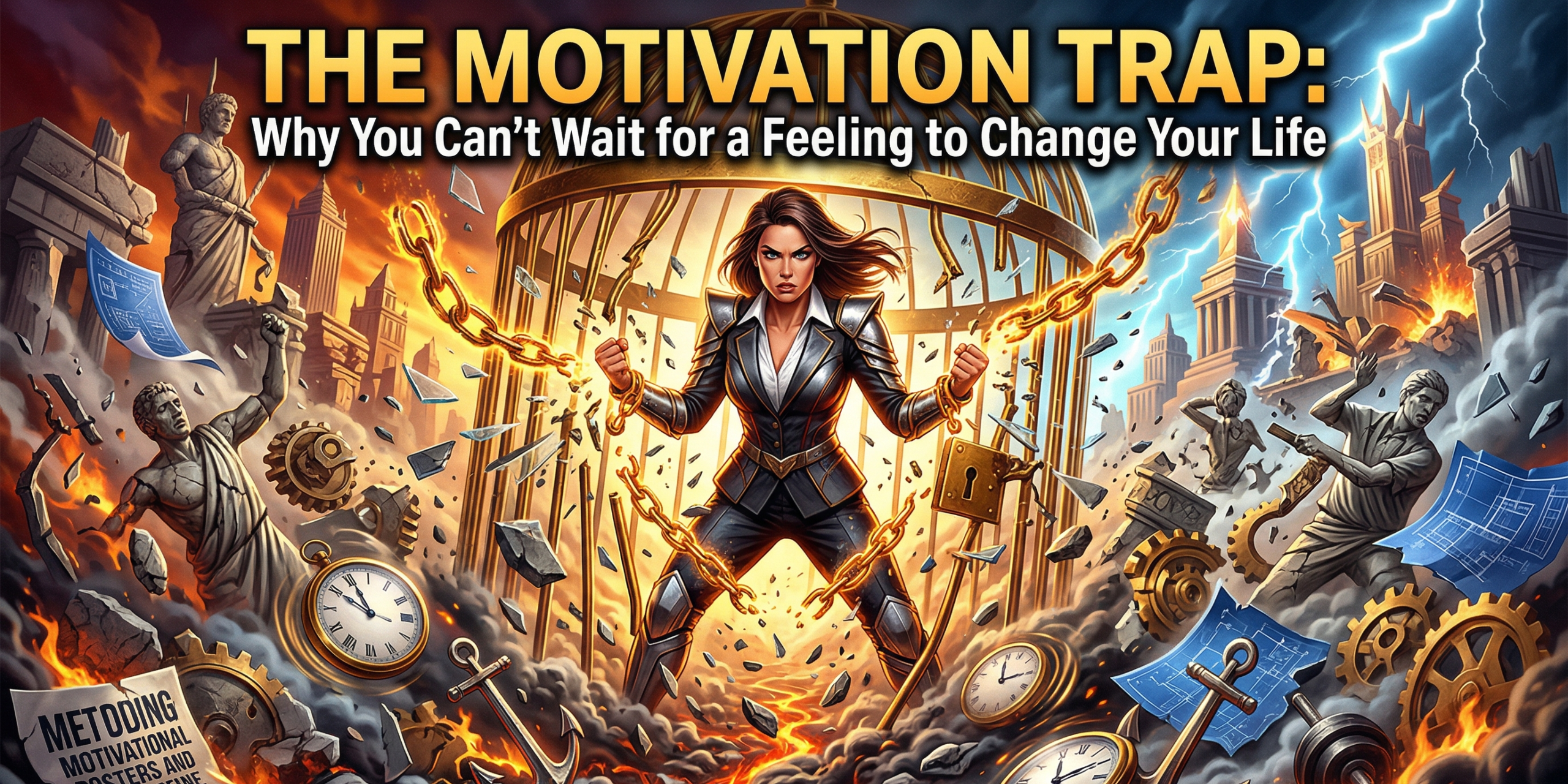
There is a specific, invisible wall that every high-achiever eventually hits.
You wake up, the alarm goes off, and you stay there. You know exactly what you need to do. You have the “Strategies for Success” saved in a folder. You have the gym shoes by the door. You have the business plan open on your laptop. But when you reach for that internal spark—that surge of “let’s go”—it’s not there.
So you wait.
You tell yourself that you’re just “not feeling it” today. You decide that you’ll start tomorrow, when you’re more rested, more inspired, or more “motivated.” You treat motivation like a weather pattern—something that happens to you, rather than something you control.
This is the Motivation Trap.
It is the belief that action must be preceded by an emotion. It is the dangerous assumption that you need to “feel like” doing the work before the work can begin. And it is the single most common reason why brilliant people stay stuck in mediocre lives.
The Biology of the Waiting Room
To understand why you’re stuck, you have to understand that your brain is a survival machine, not a success machine.
Your brain’s primary job is to conserve energy and keep you safe. “Lasting Change”—starting the business, writing the book, shifting your career—requires a massive expenditure of energy and involves a high degree of social and emotional risk.
To your primitive brain, this looks like a threat.
So, it does what it was designed to do: it kills your motivation. It releases a chemical signal that makes you feel sluggish, doubtful, and “uninspired.” It isn’t that you’ve lost your drive; it’s that your brain is successfully “protecting” you from the discomfort of growth.
If you wait until you “feel motivated” to act, you are essentially giving your biological safety-valve permission to run your life. You are waiting for permission from the very system that is trying to keep you exactly where you are.
The Amateur vs. The Professional
The difference between an amateur and a professional isn’t talent. It isn’t even results.
The difference is their relationship with their “feelings.”
An amateur believes they must be in the “right mood” to create, to lead, or to grow. They are a slave to their internal weather. If the sun is out and the dopamine is flowing, they are unstoppable. But the moment a cloud rolls in, they vanish. Their life is a series of “starts” and “stops” that never quite gain momentum.
A professional understands that motivation is a luxury, but discipline is a requirement.
The professional shows up when they are tired. They show up when they are bored. They show up when they are terrified. They have decoupled their actions from their emotions. They don’t ask, “Do I feel like doing this?” They ask, “Did I say I would do this?”
When you make your actions mood-independent, you gain a superpower. You become a person who can be trusted by the market, by your team, and—most importantly—by yourself.
The “Action First” Feedback Loop
We’ve been taught the sequence of change backwards.
We think the sequence is: Motivation → Action → Result. We wait for the “feeling” (Motivation) so we can do the “thing” (Action) and get the “outcome” (Result). But in the real world, the sequence actually looks like this:
Action → Result → Motivation.
Motivation is not the fuel that starts the engine; it is the heat the engine produces once it is already running.
When you force yourself to take even the smallest, most pathetic step forward despite “not feeling it,” you create a tiny result. That result—the finished paragraph, the sent email, the ten-minute workout—triggers a hit of dopamine. Your brain says: “Oh, we’re doing this. And we’re actually okay.”
That dopamine hit is the motivation.
You don’t think your way into a new way of acting; you act your way into a new way of thinking. The “feeling” follows the “doing”—every single time.
Engineering a Mood-Independent Life
If you want to escape the trap, you have to stop relying on your “inner drive” and start relying on your Internal Architecture.
The Ritual of Re-Entry Stop deciding what to do every morning. Decision fatigue is the best friend of the Motivation Trap. If you have to “decide” to work out, you will eventually decide not to. If you have to “decide” to write, you will eventually find an excuse. Eliminate the choice. Set a “Non-Negotiable” start time. When the clock hits 8:00 AM, the work begins. Not because you’re inspired, but because it’s 8:00 AM.
The “Five-Minute” Rule When the resistance is high, tell yourself you will only do the task for five minutes. Anyone can do anything for five minutes. Usually, once the “Initial Friction” is broken and you’re five minutes deep, the brain’s “Safety Valve” lets go, and you find the flow you were waiting for.
The Identity Shift Stop saying “I’m trying to be more motivated.” Start saying “I am a person who follows through.” When you make it about your Identity rather than your Emotion, the game changes. You don’t “feel like” brushing your teeth every night, but you do it because you are a person who values hygiene. Apply that same identity-logic to your professional and personal growth.
The High Cost of the “Inspiration High”
Relying on motivation is a form of emotional addiction.
You become a “High-Hunter.” You wait for the seminar, the video, or the podcast that gives you that temporary rush of “potential.” You get high on the idea of change, which feels almost as good as actually changing—but requires none of the work.
But like any high, it eventually wears off. And when it does, the “Normal World” feels even heavier than before.
The most successful people in the world are often the ones who have the most “boring” relationship with their work. They aren’t constantly “hyped.” They are simply consistent. They have realized that a thousand “boring” days added together create a result that looks like magic to everyone else.
The 30-Day Motivation Detox
If you’ve been waiting for a “feeling” to change your life, it’s time to perform a manual override.
Week 1: The “No-Mood” Audit For seven days, perform one difficult task every day at exactly the same time. Do not check your “mood” beforehand. Just execute. Notice how the resistance tries to talk you out of it—and do it anyway.
Week 2: The Environmental Shield Remove the triggers that allow you to procrastinate. If you wait for “motivation” by scrolling through your phone, put the phone in another room. Make it harder to stay stuck than it is to move forward.
Week 3: The Victory of the Boring Focus on the “Low-Energy Win.” When you feel your worst, do the absolute minimum version of your habit. Five pushups. One sentence. One phone call. Prove to your brain that your “state” does not dictate your “output.”
Week 4: The Integration Look back at the last 21 days. You’ll realize that you’ve made more progress in three weeks of “uninspired” consistency than you did in three months of “waiting for a sign.”
The Ultimate Form of Self-Care
We think that “following our feelings” is a way of being kind to ourselves.
But letting your fleeting emotions dictate your future is the ultimate form of self-sabotage.
Real self-care is the discipline required to build a life you don’t need to escape from. It is the “Inner Fire” that stays lit even when the wind is blowing. It is the quiet, steady confidence that comes from knowing that you—not your moods—are the architect of your destiny.
Stop waiting to feel like it. The feeling isn’t coming to save you. The action is the rescue.
Pick up the tools. Start the clock. The motivation is waiting for you at the finish line.













Leave a Reply