
There is a strange, quiet identity crisis that happens in the middle of a successful life.
You’ve checked the boxes. You’ve built the career, you’ve managed the household, and you’ve fulfilled the roles that society—and your family—expected of you. You are a “professional,” a “partner,” a “parent,” or a “provider.” These labels are proud ones, and you wear them well.
But every now and then, in the silence between meetings or the drive home, a question bubbles up that you don’t quite know how to answer:
“Who am I when I’m not being useful to someone else?”
For most of us, our identity has become a collection of services we provide to the world. We have become so optimized for our “roles” that we have forgotten our “roots.” We have lost the signal of our own character underneath the noise of our obligations.
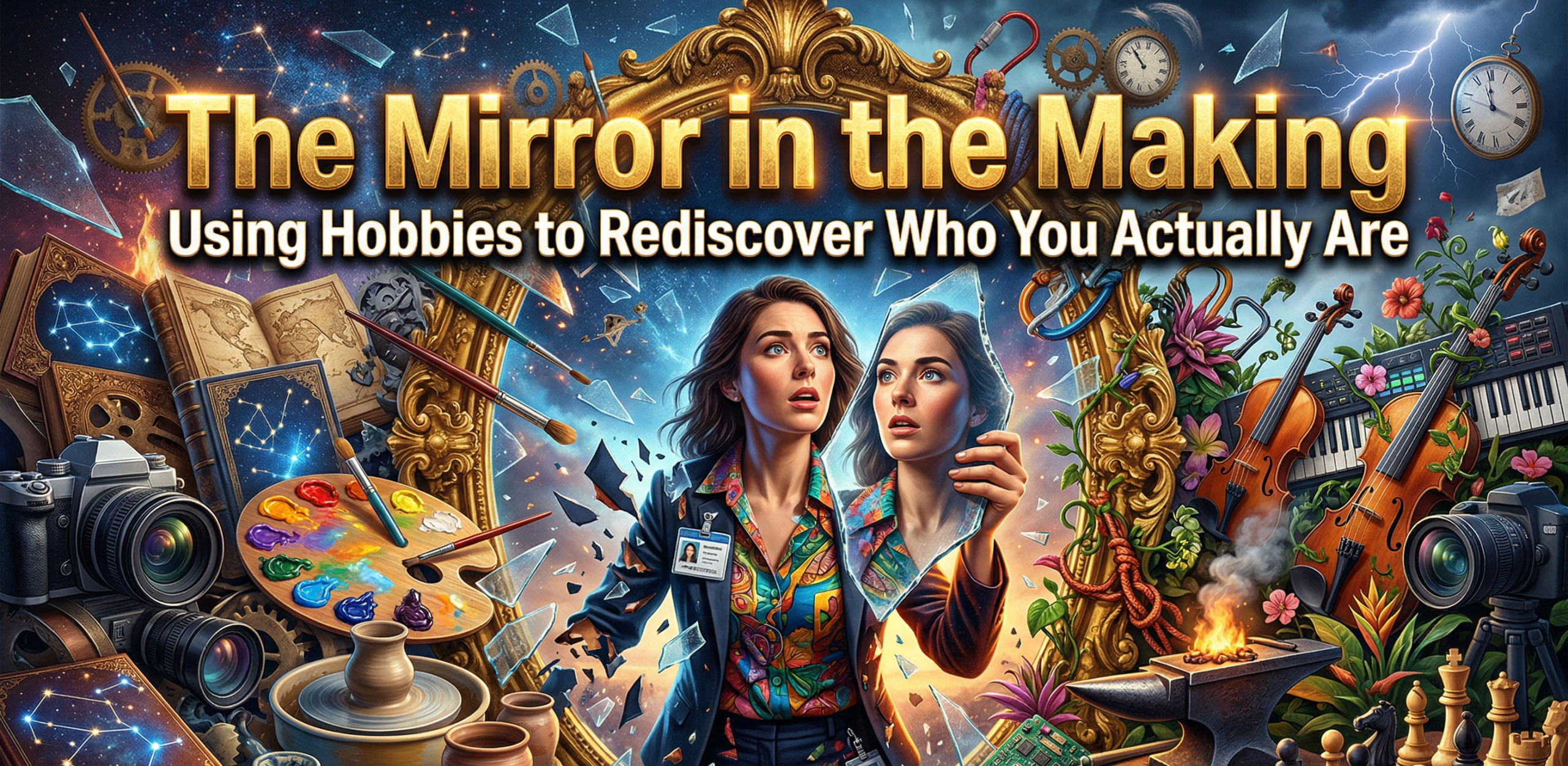
This is where the passion project moves from being a “pastime” to being a necessity. Your hobbies are not just ways to relax; they are mirrors. They are the only places left where you can see your true reflection without the mask of the professional or the weight of the provider.
The Professional Mask and the Death of Curiosity
In your “real” life, you are expected to have the answers.
You are rewarded for being predictable, reliable, and efficient. This requires you to wear a mask—a version of yourself that is sanded down and polished for public consumption. Over years of wearing this mask, the skin underneath begins to change. You stop asking “What do I want?” and start asking “What is required?”
Passion projects are the antidote to this slow erosion of the self.
When you engage in a hobby—whether it’s restoring an old engine, writing poetry, or learning the technicalities of high-altitude gardening—there is no audience. There is no performance review. There is no “bottom line.”
In that vacuum of expectation, your true curiosity begins to breathe again. You start to remember what it feels like to do something simply because it makes your brain light up, not because it makes your bank account grow.
What Your Hobby Reveals About Your Soul
Most people think they choose their hobbies. In reality, your hobbies choose you based on the parts of your identity that are being suppressed in your daily life.
Look closely at what you are drawn to when no one is watching:
- The Detail-Oriented Creator: If your job is chaotic and abstract, you might find yourself drawn to woodworking or coding—places where logic is absolute and every millimeter matters. Your hobby is telling you that you crave Order.
- The High-Stakes Explorer: If your life feels safe and repetitive, you might find yourself drawn to rock climbing or solo travel. Your hobby is telling you that you crave Autonomy and Risk.
- The Quiet Architect: If your day is filled with constant meetings and social noise, you might be drawn to painting or long-distance running. Your hobby is telling you that you crave Solitude and Internal Reflection.
Your passion project is a diagnostic tool. It shows you the “nutritional deficiencies” in your current identity. If you listen to it, it will tell you exactly what you need to change in your “real” life to feel whole again.
The Psychology of “Unproductive” Self-Discovery
We feel guilty when we spend time on our passions because we’ve been brainwashed by the “Cult of Utility.”
We’ve been taught that if an hour doesn’t produce a “result,” it’s a wasted hour. But self-discovery is, by definition, an unproductive process. You cannot “optimize” the search for your soul. You cannot “streamline” the process of finding out what moves you to tears or makes you lose track of time.
When you allow yourself to be “unproductive” in a passion project, you are performing a radical act of self-respect. You are telling yourself that your joy is a valid enough reason to exist.
This shift in perspective is the “Secret Switch.” Once you realize that you don’t need a “reason” to create, you stop looking for “permission” to lead. The confidence you find in the hobby—the realization that you are a person with unique tastes, skills, and drives—becomes the foundation of a much stronger, more authentic professional presence.
The 3 Pillars of Discovery Through Creation
To turn a project into a mirror, you need to engage with it in a way that bypasses your “ego.”
1. Radical Honesty in the Process Don’t pick a hobby because it looks “cool” on Instagram or because it sounds “impressive” at a cocktail party. Pick the thing that you feel slightly embarrassed to love. The thing that feels “geeky” or “too simple.” The more “un-cool” the hobby feels to your professional ego, the closer it is to your true self.
2. The Commitment to the “Ugly Phase” Every passion project has a phase where you are objectively terrible at it. In your career, you avoid this phase at all costs. In your hobby, you must embrace it. Watching yourself handle frustration, incompetence, and failure in a low-stakes environment reveals your true character. Do you quit? Do you get angry? Do you laugh? That is who you are.
3. The Protection of the “Quiet Space” Do not monetize it. Do not “share” it for validation until it is a part of you. Discovery requires a closed loop. The moment you invite an audience into your passion project, you start performing again. Keep it private until the reflection in the mirror is clear enough that you no longer need anyone else to verify it.
Navigating the “Guilt of the Self”
The hardest part of self-discovery is the feeling that you are being “selfish.”
You worry that the time you spend on your project is time you are “taking away” from your family or your work. But the opposite is true.
A person who has a clear sense of their own identity is a better partner, a better parent, and a more effective leader. When you are “full” of your own passion, you don’t look to others to fill your empty spaces. You show up as a whole person, rather than a collection of needs and obligations.
Self-discovery isn’t a luxury; it’s a responsibility. If you don’t know who you are, you cannot truly be there for the people you love.
The 30-Day Mirror Audit
If you’ve lost the “signal” of who you are, use the next month to find it again.
- Week 1: The Nostalgia Hunt. Think back to when you were 12 years old. What did you do when you had “nothing to do”? That version of you didn’t have a “brand” or a “career.” Go back to that activity.
- Week 2: The Action Phase. Spend 30 minutes, three times this week, in that activity. Don’t worry about being good. Just watch your “Internal Weather.” How does your body feel? What thoughts come up?
- Week 3: The Pattern Recognition. Look at the choices you make in your hobby. Do you like to follow the instructions, or do you like to “wing it”? Do you like the beginning of the project, or the finishing touches? These are your “Intrinsic Drivers.”
- Week 4: The Integration. Take one “discovery” from your hobby—maybe your love for quiet focus or your need for creative risk—and find a small way to bring it into your workday.
The Final Reflection
You are not a list of accomplishments. You are not your job title. You are not the person everyone else expects you to be.
You are a complex, vibrant, evolving human being who has a deep need to create, to play, and to be seen—first and foremost, by yourself.
Your passion project is the bridge back to that person. It is the place where you can stop “doing” and start “being.”
The mirror is waiting. Pick up the brush, the tool, or the pen. Look closely.
The person you’ve been looking for has been there the whole time.






Leave a Reply